

N20D0 series rotary buffer
N20D0 series rotary buffer
-
Price
-
Minimum Quantity
1
| SKU | Standard | Type |
|---|---|---|
|
|
|
|
TAG:
Category:
Rotary buffer
Product Specifications
| model | torque | reverse torque | Torque output direction |
|
N20D(J)0-R103 |
1N·m (10Kgf.cm) |
0.3N·m (3kgf.cm) |
Clockwise direction |
|
N20D(J)0-L103 |
1N·m (10Kgf.cm) |
0.3N·m (3kgf.cm) |
counterclockwise |
|
N20D(J)0-R203 |
2N·m (20Kgf.cm) |
0.6N·m (6kgf.cm) |
Clockwise direction |
|
N20D(J)0-L203 |
2N·m (20Kgf.cm) |
0.6N·m (6kgf.cm) |
counterclockwise |
|
N20D(J)0-R303 |
3N·m (30Kgf.cm) |
1.0N·m (10kgf.cm) |
Clockwise direction |
|
N20D(J)0-L303 |
3N·m (30Kgf.cm) |
1.0N·m (10kgf.cm) |
counterclockwise |
Note (1) The specification torque is the data when the temperature is 23±2℃;
Note (2) The white end caps are counterclockwise torque output products, and the black end caps are clockwise torque output products;
Note (3) Special torque customization can be provided by changing the viscosity of the buffer viscous oil;
Note (4) "J" in the model number indicates that the rotating shaft is a product with a zinc alloy shaft.
| Maximum use angle |
110° |
| Operating temperature range |
-5~50° |
| Rotary shaft material |
PPS |
| Material of product housing and end caps |
PBT |
| use oil | silicone oil |
Different installation specifications
|
|
N20D0 |
N20D1 |
N20D2 |
N20D3 |
N20D4 |
N20D5 |
N20J0 |
N20J1 |
| Rotary shaft material |
PPS |
PPS |
PPS |
PPS |
PPS |
PPS |
ZDC |
ZDC |
| Rotation shaft length |
20mm |
20mm |
10mm |
10mm |
25mm |
25mm |
20mm |
20mm |
| Length of rear mounting position |
3mm |
5mm |
3mm |
5mm |
3mm |
5mm |
3mm |
5mm |
| product weight |
14.6±1g |
14.8±1g |
10.3±1g |
10.5±1g |
11.5±1g |
11.8±1g |
26.5±1g |
26.7±1g |
Instructions for use
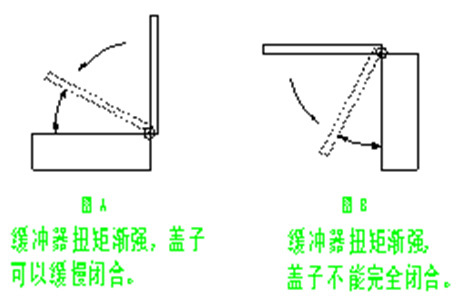
1. When the N20D0 series rotary buffer starts to drop from the vertical position as shown in Figure A to the horizontal position, since the designed torque is the weakest at the starting position, the torque gradually increases with the rotation of the buffer angle, so the action of the cover can be Finally close slowly. As shown in Figure B, when the lid starts to fall from the horizontal position, the torque generated by the gravity of the lid is zero in the vertical direction, and the torque of the buffer is the largest in the final position, so the lid cannot be fully closed.
2. When using the rotary damper in the example shown in the figure, please calculate the required torque according to the following calculation method.
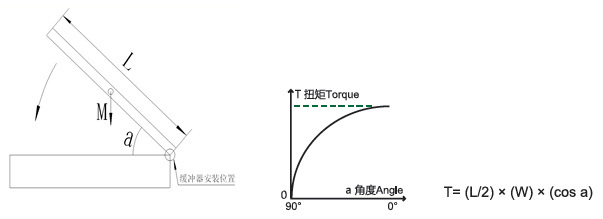
example:
Cover weight M: 1.5kg
The length L of the rotating shaft from the edge of the cover plate: 0.4m
Load torque: T=1.5×0.4×9.8÷2=2.9N•m
From the above calculation we select the buffer as N20D0-303.
3. Please minimize the gap between the rotary shaft and the joint parts. If there is a gap, the speed of the cover plate will be affected when it is rotated and dropped.
4. The torque of the shock absorber also changes according to the change of the ambient temperature. The change rule is that when the ambient temperature increases, the torque decreases, and the action time is accelerated. When the ambient temperature decreases, the torque increases and the action time slows down. This is because the viscosity of the viscous oil also changes when the ambient temperature changes. But when the ambient temperature returns to normal temperature, the torque will also return to its original value.
5. The rotation angle of the N20D0 series rotary buffer is 110 degrees. If the rotation exceeds 110 degrees, the buffer may be damaged. Please install a stop mechanism externally. The angle of action is based on the closed position.
6. The torque generating direction of the buffer varies according to the structure of the buffer. Please select the appropriate buffer according to different usage methods.


© 2026 Nimbr Technology Co.,Ltd. All Rights Reserved.